Introduction
Watch any group of four-year-olds gathered around a low art table, and a familiar pattern quickly emerges. Small hands grip chunky crayons with intense concentration, pressing down hard as the tips wander haphazardly across paper, missing intended targets by wide margins. That messy scribble is the vital precursor to formal literacy, representing a crucial developmental stage where young minds connect visual intent with physical output. Navigating this stage successfully requires targeted tools that capture imagination while building essential muscle memory. Enter the free printable tracing worksheet titled “a tracing boat for four year-old,” a carefully engineered resource designed to bridge the gap between playful drawing and structured pre-writing mechanics. According to the American Occupational Therapy Association, foundational fine motor control established during the preschool years directly predicts future handwriting legibility and academic endurance.
💡 Educational Key Takeaways:
- Core Skill: Structured A Tracing Boat For Four Year-Old focused on developing pencil grip, stroke control, and early literacy/math confidence.
- Target Scope: Suited for homeschoolers, preschool, kindergarten, and elementary learners.
- Best Recommendation: Practice 10–15 minutes daily with ergonomic writing tools to reinforce muscle memory without hand fatigue.
What This Worksheet Covers
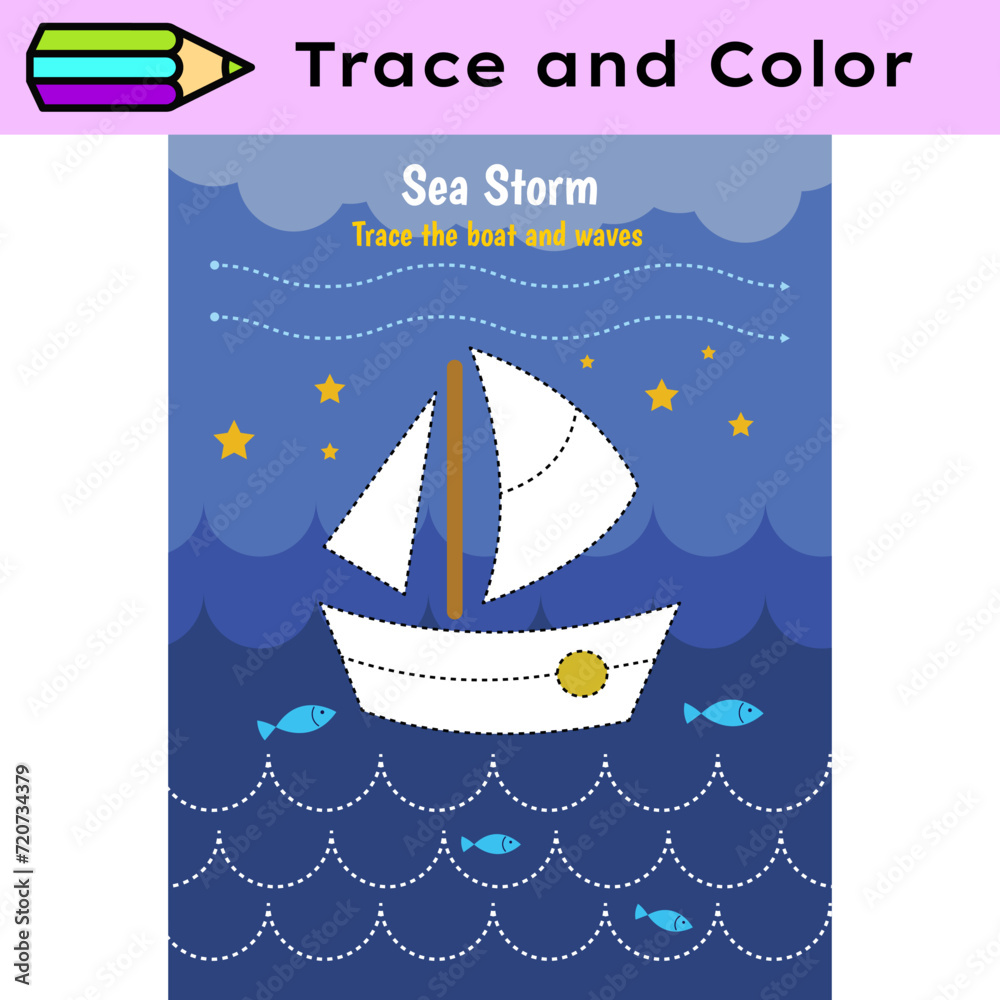
Targeting the specific biomechanical needs of four-year-old learners, this nautical-themed printable features bold, continuous dotted lines that form the hull, sails, and gentle ocean waves beneath a seafaring vessel. Spatial planning gets a gentle workout as children navigate from left to right, matching the directional flow required for eventual reading and writing tasks. It sounds simple—and that’s the point. Complex worksheets overwhelm young nervous systems, whereas a single, charming boat provides a clear visual anchor that sustains attention span. Building foundational strength in the small intrinsic muscles of the hand requires engaging contexts, which is why thematic resources consistently outperform abstract line drills in clinical settings.
Key Learning Outcomes
Mastering stroke coordination involves more than just keeping a pencil on paper. Visual-motor integration takes center stage as the brain instructs the hand to execute precise curves and straight paths simultaneously. Crossing the body’s midline happens naturally as little hands track the wide sails from edge to edge, an action heavily emphasized across multiple developmental frameworks. Furthermore, sustained bilateral coordination improves as the non-dominant hand stabilizes the paper while the dominant hand traces the route. Educators utilizing resources found within Fine Motor and Pre-Writing Skills collections regularly observe rapid gains in pencil pressure regulation and spatial awareness among preschoolers.
How to Use This Worksheet
Facilitating successful tracing sessions relies heavily on environmental setup and tool selection. Heavy cardstock works best for printing, preventing the paper from buckling under heavy grips and damp marker tips. Here’s what makes this worksheet different: it invites multisensory engagement before a single mark touches the page. Adults can encourage children to trace the boat outline with a clean index finger first, feeling the physical contours of the waves and sails. Transitioning from tactile tracing to writing utensils becomes seamless once that sensory memory is established. Pairing this activity with options from Shape and Line Tracing galleries ensures children build comprehensive stroke repertoires.
Practical Tips for Parents and Teachers
Observing pencil grasps closely during early tracing exercises prevents the formation of inefficient habits that prove difficult to break later. Encouraging a functional tripod grasp matters, but supporting foundational shoulder and core stability remains equally critical for long-term writing endurance. Short, joyful bursts of practice yield far better neurological results than forced, lengthy drills. Keeping a variety of writing instruments—such as broken beeswax crayons, short golf pencils, or scented markers—adds novelty without increasing frustration. According to the National Association for the Education of Young Children, play-based learning environments that incorporate meaningful graphic representations significantly boost early literacy engagement.
Age-Appropriate Recommendations
Four-year-olds operate comfortably within the pre-schematic stage of graphic development, where controlled scribbles evolve into recognizable symbols and purposeful lines. Alignment with the National Association for the Education of Young Children Developmentally Appropriate Practice ensures that expectations match neurological and physical maturation rates. Children younger than four might find the directional changes on the boat worksheet challenging, while older kindergarteners can use the same template to practice scissor cutting skills along the traced paths. Expanding skill sets further is easily achieved by exploring additional printables located in Seasonal and Fun Themes categories.
Foundational fine motor control established during the preschool years directly predicts future handwriting legibility and academic endurance. — American Occupational Therapy Association
Frequently Asked Questions
Navigating the implementation of pre-writing resources often brings up common logistical and developmental questions for educators and caregivers alike. Clear guidance ensures that every tracing session remains a positive, confidence-building experience for young learners.
Explore More Free Printable Tracing Worksheets
Expanding a child’s fine motor toolkit requires access to a diverse array of engaging, developmentally sound resources. Discovering fresh ways to practice pencil control keeps motivation high and learning fun throughout the entire preschool year. Browse through specialized collections such as Tracing Worksheets to find endless inspiration for daily practice.
Download a free printable tracing boat worksheet for four-year-olds. Expert tips on fine motor development, pre-writing skills, and pencil grip mechanics.
💬 Frequently Asked Questions
Developmental Milestone & Activity Table
| Development Stage | Recommended Daily Duration | Primary Learning Objective |
|---|---|---|
| Preschool & Pre-K | 10 – 15 Minutes | Pencil grip development & basic pre-stroke lines |
| Kindergarten | 15 – 20 Minutes | Letter/number formation & spatial line awareness |
| Early Elementary (Grade 1–2) | 20 – 30 Minutes | Fluency, sentence construction & neatness |